AC Outside Unit Humming but the Fan Won't Spin? Here's the Part to Blame
Home electrical systems are often taken for granted until warning signs begin to appear. Outdated wiring, frequent circuit trips, flickering lights, or burning odors can indicate deeper electrical issues that may compromise safety and performance. Rewiring is not just a technical upgrade; it is a critical step toward ensuring a home remains safe, efficient, and compliant with modern electrical demands. As households increasingly rely on high-powered appliances, smart devices, and HVAC systems, older wiring systems struggle to keep up with the load.
This guide breaks down the rewiring process in a clear and practical manner, helping homeowners understand what happens before, during, and after the work is completed. From initial inspection to final testing, each stage plays a vital role in ensuring a reliable electrical system. With the right knowledge, homeowners can confidently navigate the process and recognize the importance of professional electrical work in maintaining a secure living environment.
What the Humming Actually Means
The hum tells you something useful. It means the unit is getting power and a component inside is energized and trying to work. This is different from a unit that is completely silent and dark, which usually points to a tripped breaker, a blown fuse, or a thermostat that never sent the call for cooling.
When you hear the hum but see no fan movement, the motor is receiving voltage but cannot get over the hump to start turning. An electric motor needs an extra push of energy to break from a dead stop into a spin. Once it is moving, it keeps moving on far less power. The part responsible for that initial push is the capacitor — and when it weakens or dies, the motor just sits there and buzzes, drawing current it cannot use.
The Usual Culprit: A Failed Run Capacitor
In the large majority of hum-but-no-spin calls, the problem is the capacitor.
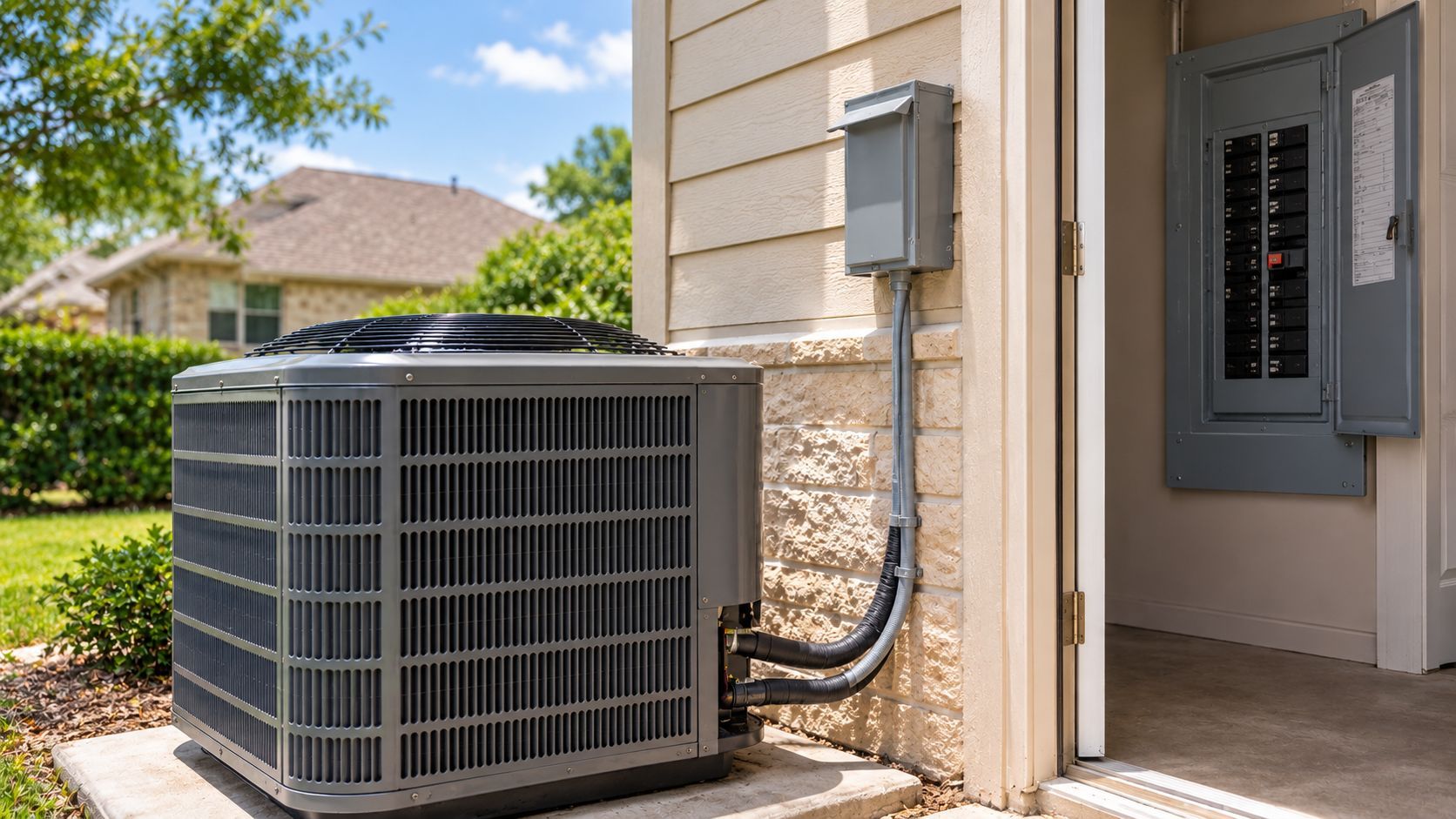
What it does. A capacitor is a small cylindrical part inside the access panel of the outdoor unit. Think of it as a battery that stores a burst of energy and releases it the instant the motor needs to start. Most outdoor units use a dual capacitor that serves both the fan motor and the compressor. When the fan side weakens, the blade struggles to start.
Why it fails in Texas. Heat is the enemy of a capacitor. Central Texas summers run long and hot, and a condenser sitting in direct sun bakes the components inside it day after day. That sustained heat dries out and degrades the capacitor over time, which is why these failures cluster in June, July, and August rather than in spring. A capacitor that tested fine in April can give out during the first real heat wave.
How you can tell.
A failed capacitor usually shows the exact symptom you are seeing — a humming unit with a motionless fan. Sometimes the top of the capacitor bulges or looks domed instead of flat, or there is an oily residue around it, though plenty of dead capacitors look perfectly normal from the outside. The only reliable confirmation is a meter reading, which a technician takes in a few seconds with the power off.
Other Reasons the Fan Won't Spin
The capacitor is the leading suspect, but it is not the only one. A good diagnosis rules out the rest.
A burned-out fan motor. Motors wear out. The bearings can seize, or the internal windings can fail after years of running through hot summers. A motor that has overheated often gives off a faint burnt-electrical smell. If a technician installs a known-good capacitor and the fan still will not turn, the motor itself is usually the answer.
A stuck or pitted contactor. The contactor is the electrical switch that sends power to the fan and compressor when the thermostat calls for cooling. Its contacts can pit, corrode, or stick from constant arcing. A failing contactor can leave the unit partially energized, which produces a hum without a clean start.
Debris jamming the blade. Sometimes the cause is mechanical and simple. A stick, a chunk of mud-dauber nest, a buildup of cottonwood fluff, or a warped blade can physically block the fan from turning. The motor strains against the obstruction and hums. This is the one cause a homeowner can sometimes spot and clear, with the power off first.
An overheated motor on thermal cutoff. Some fan motors have a built-in overload that shuts the motor down when it gets too hot, then resets once it cools. If the fan runs for a while and then quits during the hottest part of the day, a motor running on the edge of failure may be the reason.
What You Can Safely Check Yourself
There are a few things you can look at before you call for service, as long as you respect the electrical risk inside the unit.
Shut it down first. Set the thermostat to off, then go to the outdoor disconnect box near the condenser or the AC breaker in your panel and cut the power. Do not skip this step. The fan blade and the wiring inside are not safe to touch while the unit is energized.
Look for an obvious jam. With the power off, look down through the top grille. If you can see a branch, a nest, or thick debris wedged against the blade, that may be your whole problem. Clearing it can let the fan spin freely again once power is restored.
Do a gentle spin test. Still with the power off, use a long stick or a screwdriver through the grille to give the fan blade a light push. If the blade spins freely and coasts, the motor bearings are probably fine, which points more toward the capacitor. If the blade is stiff, grinding, or will not budge, the motor or a mechanical jam is more likely. This test only narrows things down — it is not a fix.
WARNING Never reach into the outdoor unit or open the side access panel yourself. The capacitor stores a high-voltage charge even after the power is off and can deliver a dangerous shock long after the unit is unplugged. Testing and replacing it is a job for a trained technician with the right tools.
Why Running It Anyway Risks the Compressor
It is tempting to leave the system on and hope the fan catches, but that is the one thing that turns a small repair into a large one.
The outdoor fan has a specific job: it pulls air across the condenser coil to carry heat away from the refrigerant. When the fan stops, that heat has nowhere to go. The compressor — the most expensive single part in the whole system — keeps running and keeps building pressure and temperature with no way to shed it. Within minutes it can overheat. Push it long enough and the compressor can fail outright, which is the difference between replacing a small part and facing a major repair or a new unit.
That is why the safest response to a humming unit with a still fan is to turn the system off and leave it off until it is looked at. A few hours without cooling is an inconvenience. A burned-out compressor in the middle of a Texas August is a much bigger one.
TIP If a gentle spin test gets the blade moving and the fan keeps running after you restore power, do not assume the problem is solved. A weak capacitor can still start a warm motor on a good day and fail again on a hotter one. Have it tested so you are not stranded during the next heat wave.
Frequently Asked Questions
Can I just replace the AC capacitor myself?
It is not recommended. The capacitor holds a high-voltage charge even after the power is cut, and discharging and replacing it safely takes the right tools and training. Matching the exact voltage and microfarad rating also matters — the wrong part can damage the motor. This is a quick job for a technician but a real hazard for a homeowner.
How long does a capacitor last?
A run capacitor often lasts several years, but heat shortens its life. In a hot climate where the unit runs hard for months at a time, capacitors tend to fail sooner than they would in a milder region. Many failures show up during the first stretch of extreme heat each summer.
Why did my fan stop only on the hottest day of the year?
Heat is usually the trigger. A capacitor that is already weak can still start the fan on a mild day but loses just enough strength on a very hot one to leave the motor humming. The hottest afternoon of the summer is exactly when a borderline part tends to give out.
Is a humming AC dangerous to leave running?
It can lead to expensive damage. With the fan stopped, the compressor overheats quickly because the heat it produces is not being carried away. Leaving the system running in that state risks the compressor, so it is best to shut it off until a technician checks it.
My fan spun when I pushed it with a stick — is it fixed?
Not necessarily. If the blade needed a manual push to start, that is a classic sign of a weak or failed capacitor. The motor may run for now, but the underlying part is still failing and will likely strand you again. A test confirms whether the capacitor needs to be replaced.
What's the difference between the fan not spinning and the whole unit being dead?
A humming unit with a still fan is getting power but cannot start the motor, which points to a capacitor, motor, or contactor. A unit that is completely silent and unresponsive usually has an electrical supply problem, such as a tripped breaker, a blown fuse, or a thermostat issue. The two call for different diagnostics.
Why a Weak Capacitor Deserves Quick Attention
A humming outdoor unit with a fan that refuses to turn almost always traces back to one small, inexpensive part rather than a failing system. The capacitor gives the motor its initial push, and once heat wears it down, that spark disappears. Ruling out debris, a stuck contactor, or a burned motor takes only a few minutes with the right tools. What matters most in that moment is resisting the urge to let the unit keep running while you wait and see.
Shutting the system off at the thermostat and breaker protects the compressor from the overheating that follows a stalled fan, buying time until a proper diagnosis can happen. Homeowners in Belton, Texas have relied on
CenTex Superior Services
for over 40
years to sort out exactly this kind of problem, testing the capacitor, motor, and
contactor to find the real cause before any part is replaced. A quiet, still fan is fixable — it just needs the right eyes on it.